Pages

Thursday, July 15, 2010

Leonardo da Vinci’s ‘The Virgin of the Rocks’ Returns to National Gallery


Leonardo da Vinci, The Virgin of the Rocks, about 1491 - 1508. National Gallery, London

Sometimes even a Renaissance man needs to clean up. Yesterday, London’s National Gallery rehung Leonardo da Vinci’s iconic “The Virgin of the Rocks” after putting the painting through an 18-month cleaning.

A glossy varnish applied to the work around 1948 was removed because it had been to yellow, crack and overshadow some of the artist’s subtle shading technique known as “sfumato,” according the museum. The “Virgin” also got a new gilded frame that includes cornice portions from a 1500 Italian frame.

Curators also used the time to further study the work and have concluded that the entire piece was created by Da Vinci alone, rather than with help from assistants as some scholars previously asserted. Their findings will be published in a museum bulletin next fall.

Scholars have long agreed that the work is a masterpiece. In 1483, the Milanese Confraternity of the Immaculate Conception asked Da Vinci to paint a work for their chapel’s altarpiece, but it took the artist 25 years to deliver the final product.

The work focuses on a legend in which Mary, the mother of Jesus Christ, introduces her infant son to a toddler John the Baptist. Christ is shown on the right, his hand giving a gesture of blessing. An earlier version of the same work now hangs in the Louvre; the National Gallery bought this version in 1880.

Friday, July 17, 2009

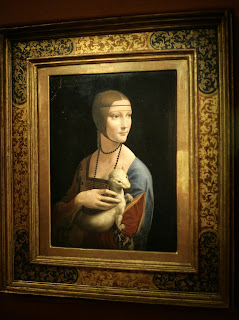
Lady with the Ermine

Like many paintings thought to be by Leonardo, controversy surrounds this picture. Some question whether it was painted by Leonardo at all.


Art historians also disagree over who the subject of the portrait was. One theory suggests it shows a young lady named Cecilia Gallerani, who would have been just seventeen when when this picture was painted. Cecilia was the mistress of Ludovico Sforza - the Duke of Milan - until Ludovico settled down and married another woman.

If the model was Cecilia, then the Ermine in the picture may have had a special meaning. The Greek for Ermine is Galee - a pun on the model's name.

Parts of this picture have been painted over at some point in its history. The background has been darkened, and X-rays show a door has been removed. The original painting showed a woman wearing a transparent veil, but this has been retouched to look like hair. The bottom two fingers have also been altered, and look less realistic than the other two.

This painting is based on curved lines, which lead the eye. From the model's face, the gaze is drawn down the sleeve, across the back of the Ermine, and then up the other arm.

The head of the Ermine in this picture is particularly lifelike. Leonardo placed emphasis on natural accuracy, and may have studied the anatomy of the creature before beginning the painting.

Sunday, July 17, 2005

A new picture by Leonardo da Vinci has been discovered, the National Gallery in London has said

“ Experts think Leonardo da Vinci was probably planning a picture of an adoration of the Christ child ” -- The BBC's Rebecca Jones

It said experts using infra-red techniques found a drawing under the surface of the Virgin of the Rocks painting which hangs at the gallery.

It believes the drawing shows a woman kneeling with one arm stretched out.

Experts believe the Italian Renaissance painter was planning a picture of an adoration of the child Christ but abandoned the idea.

Leonardo was commissioned to paint the Virgin of the Rocks to decorate an altarpiece in a chapel in Milan in 1483.

The artist appears to have painted two versions.

One, which now hangs in the Louvre, was probably sold to a private client, says BBC arts correspondent Rebecca Jones.

The other, which hangs in the National Gallery, was placed in the chapel in 1508.

It is under this painting that experts believe they have found a drawing of a kneeling woman.

She is pictured with her eyes downcast and one of her hands stretched out.

Experts think Leonardo da Vinci was probably planning a picture of an adoration of the Christ child, but abandoned the idea before drawing Jesus as a baby, our correspondent says.

However, why he painted over the work may never be known, she adds.

Milan arrival

The Virgin of the Rocks was the first painting executed by Leonardo after his arrival in Milan.

Critics have argued over exactly what the painting depicts.

Some claim it shows the Immaculate Conception, while others believe it recalls the moment when the infant Christ met St John the Baptist.

Leonardo painted the Mona Lisa, considered to be among the world's most famous paintings.

His other masterpieces include the Last Supper and Adoration of the Magi.

Story from BBC NEWS:
http://news.bbc.co.uk/go/pr/fr/-/2/hi/uk_news/4639945.stm

Published: 2005/07/01 10:18:13 GMT

Friday, January 17, 2003

Exhibition : Leonardo da Vinci and the Splendor of Poland

Lady with an Ermine (Portrait of Cecilia Gallerani)

Leonardo da Vinci, Lady with an Ermine (Portrait of Cecilia Gallerani), c. 1490
The Princes Czartoryski Museum, Cracow
Poland has a fascinating history of collecting art. Royal patrons were responsible for acquiring masterworks of art throughout the Renaissance and the Enlightenment. When Poland lost its independence in 1795 and was then partitioned geographically, the country´s art collections felt the impact. Cultural and political oppression culminated in the radical dismantling of collections and museums during Nazi and later Soviet rule. Today museums in Poland are retrieving their collections and redefining themselves within a reconfigured Europe. Many of the paintings on view were stolen or displaced during World War II, and several are being shown for the first time since their recovery and conservation. This exhibition celebrates Poland´s remarkable history of collecting and royal patronage.

The centerpiece of this stunning exhibition is Leonardo´s Lady with an Ermine. Although Leonardo´s Mona Lisa is more famous around the world, the elegant Lady is equally alluring. Leonardo depicted a teenage beauty, veiled and robed in velvet. She holds an ermine in the crook of her arm. One theory holds that the model of this portrait is Cecilia Gallerani, a mistress of Ludovico Sforza, the ruler of Milan. Although Leonardo is famous for his creative abilities, he actually completed only a few paintings. Portrait of the Lady both anticipates the artistry of Leonardo´s world-famous Mona Lisa and signals a breakthrough in the art of psychological portraiture. The exhibition also features important paintings by Bellotto, Ingres, Overbeck, and others.


This exhibition has been organized by the Milwaukee Art Museum.
On view through February 17, 2003 at the Caroline Wiess Law Building